
Context (Urban, Architectural, Public, Historical)
A urban lighting designer is an “evening architect” — so it is easy to understand that their responsibility to the community is the same as that of an architect or designer. It all comes down to setting priorities during concept development and taking into account the environment (its architecture, purpose, history) and the interests of the community. Through our approach, we shape spaces of mutual respect for the environment, always offering the client a sustainable concept that will remain relevant for as long as possible, drawing on deeper meanings and values.
Of course, compromise is always part of the conversation, since the client must ultimately be satisfied. For example, in tourist areas, the so-called tourist route can be taken into account. Context is so important that often — as strange as it may sound — it is better not to illuminate a particular façade at all, as it may be entirely out of place, spoil the perception of the space, or introduce tactless accents that distort the environment.
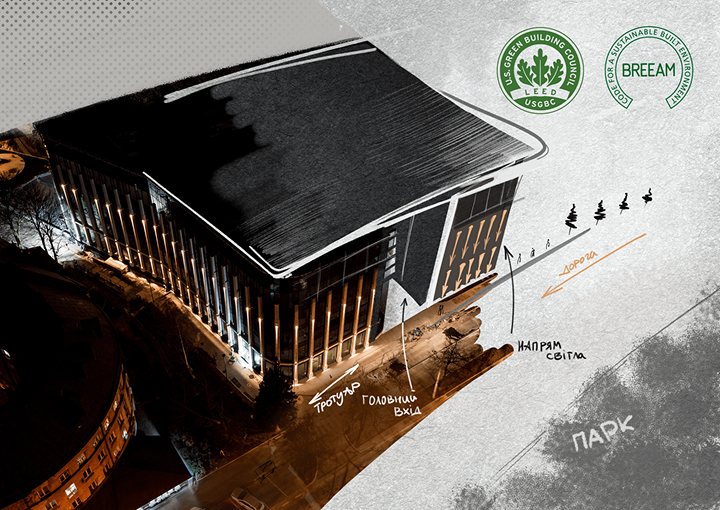
Invisible Ligh
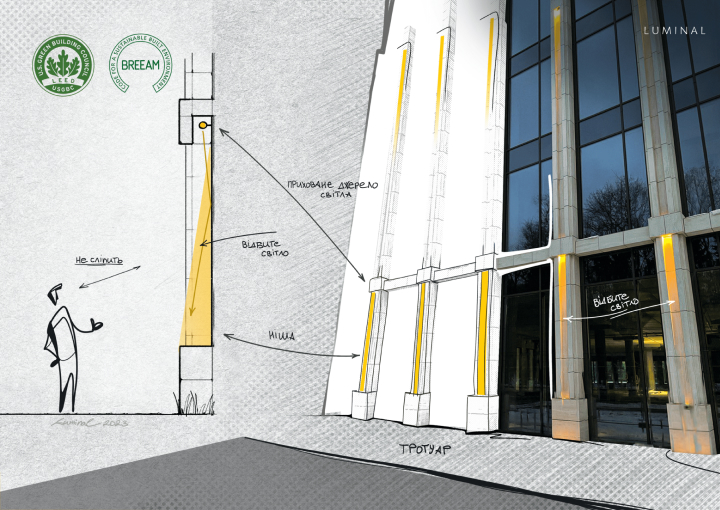
Exactly — and this is not a contradictory phrase. Light, the light source, must be invisible to the human eye. This should be an axiom for a lighting designer when creating a lighting project for spaces and objects. Of course, it is never just black and white — there are always shades of grey, and compromise is always possible. There are also other important parameters and requests from the client, architect or designer. Taking all details into account, it is not always possible to achieve invisibility of the source. But we still start from this point on every new project, because the design of subsequent stages can take a completely different direction. In particular, on the projects we will describe in more detail in future posts, we began the design process with exactly this principle.
Healthy Light
The human eye is adapted to the natural daily spectrum of sunlight — but it is not only about how the eye perceives light, it is also about the body’s processes as a whole, since a person is a complete and complex system with visual perception of the environment. In the evening hours we are particularly sensitive to the spectrum of artificial lighting, and its composition directly affects a person’s wellbeing and emotions. For example, if the overall spectrum contains a relatively low amount of red light (which is often characteristic of LED fixtures), we may experience discomfort, as in this case the pupil does not adapt to the amount of light and reflected colour becomes distorted.
This indicator correlates with the colour rendering index, and as a result, it is often noticeable in façade lighting, where elements may appear to have an unpleasant hue at night. In addition to ensuring the light source remains invisible, we also take into account an acceptable light comfort rating (GR — Glare Rating and UGR — Unified Glare Rating) — which we aim to minimise not only through the fixtures themselves, but also through design and individual engineering solutions.
Ecological Light
In developed countries, outdoor lighting standards significantly regulate the amount of blue light in the spectrum of lighting fixtures and the so-called “uplight” — light directed toward the sky. A number of studies, both theoretical and practical, demonstrate the harmful effects of distorted artificial night lighting, particularly lighting with a substantial proportion of blue spectrum, which has a biological effect on flora and fauna. It may sometimes seem that the illumination of a façade and its surrounding area does not particularly affect the environment and ecosystem around it. But this is not the case. Poorly designed lighting can affect the neighbouring building infrastructure, the surrounding territory, and even trees where birds nest — causing them to relocate to quieter, darker places.
In “vacant” areas, pest insects begin to appear uncontrollably. This then leads to an epidemic, as a result of which flora and fauna suffer. All because of errors in façade or landscape lighting. And how do the residents of neighbouring buildings feel, who — due to light pollution — are forced to read a book without turning on their home lamps, replace their curtains with blackout ones and use them permanently? The question is rhetorical. In our approach to developing lighting projects, our company is guided first and foremost by the architect’s vision and the client’s budget — but we always consider the environment and context, and draw the attention of all project participants to the importance of doing no harm.